



Lecture by Dr Iulian Bîrzescu “New Researches on the Archaic Sanctuary in Histria.”
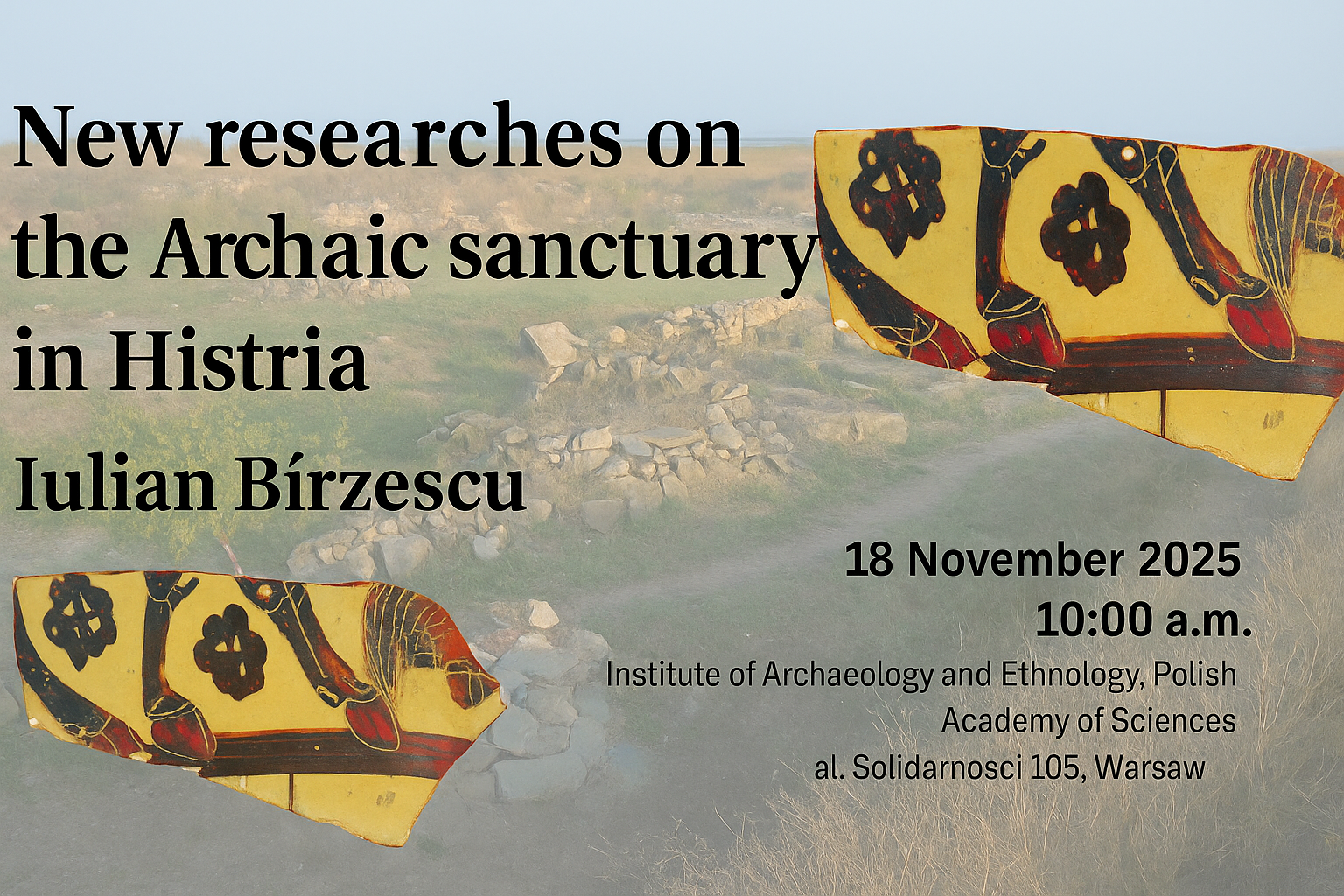
The Institute of Archaeology and Ethnology of the Polish Academy of Sciences invites you to a lecture by Dr Iulian Bîrzescu, Senior Researcher at the Vasile Pârvan Institute of Archaeology, Romanian Academy, entitled
New Researches on the Archaic Sanctuary in Histria
Tuesday, 18 November 2025, 10:00 a.m.
Institute of Archaeology and Ethnology, Polish Academy of Sciences
al. Solidarności 105, Warsaw, Room 202
The lecture will be recorded and later made available online.
It takes place within the framework of the Romanian–Polish exchange programme and the project Ancient Antiquities of the Black Sea where the video will also be accessible.
All those interested are warmly invited to attend in person or follow the lecture online.
Biographical note:
Dr Iulian Bîrzescu is Senior Researcher at the Vasile Pârvan Institute of Archaeology of the Romanian Academy in Bucharest. A specialist in Classical Archaeology and Ancient Black Sea Studies, he has been conducting research in the Sacred Area of Histria since 1996, leading the excavations there since 2007. His work focuses on the Archaic and Early Classical phases of the sanctuary and the reassessment of early architectural and votive contexts. He has also participated in international fieldwork at Miletus (Turkey) and has published extensively on Histrian topography, cult practices, and ceramic imports.
"New researches on the Archaic sanctuary in Histria"
The excavations carried on from 1915 until today in the sanctuary from the northeastern corner of Histria, known in literature as the Sacred Area, have brought to light numerous temples and other smaller constructions (altars, naiskoi, etc.) and especially a huge number of finds. In the last two decades, the main topic of these researches focused on the sanctuary of the Archaic period, with a
special regard on its early phase, from the second half of the 7th c. to the middle of the 6th c. BC. Around this time begins a new phase of intensive building activities, so that at the end of the 6th c. at least four temples were built here, one of which (Temple M) has been researched since 2007. The early phase up to Late Archaic period is characterized by modest constructions, poorly preserved, by pits with different functionalities and by several other contexts, such as a sacrificial-votive area, researched in the last decade in the northern part of the sanctuary. This area consists in altar-hearths, small and big votives found in situ or in secondary positions. The chronology of the sanctuary relies primarily on various ceramic categories, especially the Corinthian, Attic and East Greek vases. Starting from the new finds, but also from the reassessment of older ones, the paper brings into
discussion the beginnings of the Histrian sanctuary.