



Project information
Research project’s title: Serengeti of the Early Pastoralists. Searching for the origins of pastoral societies in the plains of East Africa
Project No: SONATA, UMO-2024/55/D/HS3/01454
Project lead: dr Piotr Osypiński
Project lead, institutional: Instytut Archeologii i Etnologii Polskiej Akademii Nauk
Project financing: National Science Centre, Poland
Keywords: Pastoral Neolithic, settlement patterns, chronology, adaptation strategies, Eastern Africa
Kontakt: p.osypinski(at)iaepan.edu.pl
Description:
In the Serengeti - a wildlife sanctuary of the African savannah - ancient humans other than hunter-gatherers are hard to find, hard to imagine. Yet discreet evidence on the walls of rock shelters and seemingly unnoticeable artefacts reflect the past presence of pastoralists in this landscape. The sites of the first communities known to archaeologists from the Pastoral Neolithic period, less than 5,000 years ago, can be counted on the fingers of one hand. They also mark the southernmost fringes of the early pastoral communities that migrated into East Africa from the north.
The preliminary survey we conducted in August 2024 paints a very different picture - there are many more sites of this type, both along the Mbalageti River and on the grassy plains around Sametu and Gol Kopjes. Studying these remains will help us to better understand the processes of migration southwards and the chronology of the spread of the first forms of food-producing economy in this part of the continent. In our project, we will also try to test the long-standing hypothesis about the environmental driver of these migrations in the middle Holocene, using our knowledge and experience in the study of early pastoralism on the Nile. This is the main aim of our project.
We have selected four sites in two ecological zones for excavation in order to trace possible differences between them. We intend to carry out extensive research to document not only small artefacts but also settlement remains - houses, hearths, storage facilities and perhaps burials. The excavations will be accompanied by studies of the use of the wider area - preferences for landscape forms, distance from water and mineral resources. Precise insights will be provided by aerial photographs and digital models of the sites now and in the past. To achieve this, we will use a drone combined with high precision satellite navigation (RTK GPS). This will not only streamline the data collection process but also make it safer for us archaeologists and, no doubt, for the animals of the Serengeti who are watching us closely. Our studies will pay particular attention to dietary issues, both through analysis of animal and plant remains. A modern methods workshop will enable us to study domesticated animals, herd structure and utilisation (meat and livelihoods, including milk yield) in much greater detail than before. In these analyses we will turn to molecular and genetic analyses - risky because they have not yet been used on East African material, but which offer the possibility of constructing a much better vision of early pastoral communities in their "non-human dimension" than before. In the search for plant remains, we will look at macro-remains, pollen, but also micro-residues on ceramic vessels and on the surface of stone querns.
In addition to the Principal Investigator responsible for stone tool analysis and fieldwork coordination, the research team will include specialists in archaeozoology, archaeobotany and ceramology, as well as an RTK GPS survey equipment operator. Research in the Serengeti cannot take place without close collaboration with Tanzanian researchers, who have been working for decades to build a prehistoric picture of human presence in the very cradle of our species. In addition to invaluable formal and logistical support, we will also jointly create an opportunity for the practical development of Pastoral Neolithic archaeology in northern Tanzania by inviting students from the University of Dar es Salaam to participate in field schools during the excavations.
The results of the research on ancient pastoral communities in the Serengeti will be presented both in a series of peer-reviewed articles and at international conferences. The popularisation dimension of the project includes a dedicated website and ongoing social media updates.
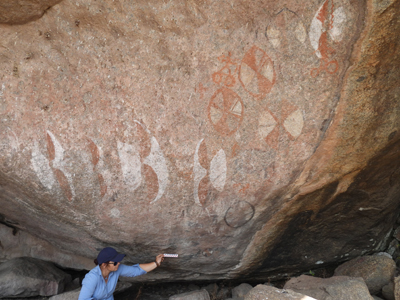
One of the shelters in Moru Kopies (Serengeti) with rock-paintings. Photo P.Osypiński
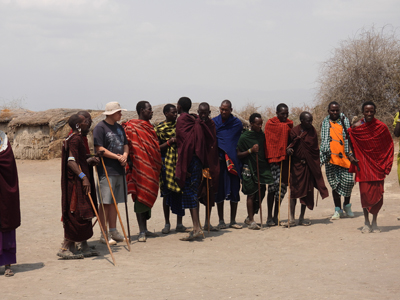
Men from the Maasai tribe near Serengeti. Photo: P. Osypiński
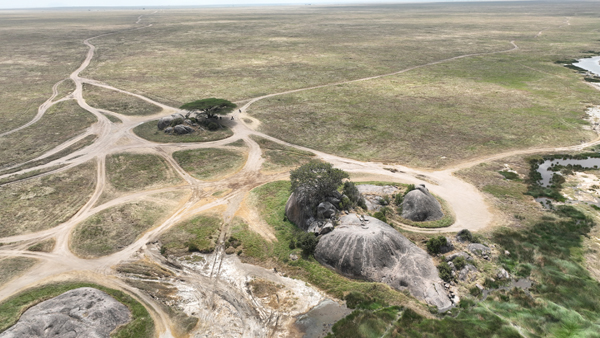
Landscape at the Neolithic settlement in Sametu (Serengeti). Drone photo F. Osypiński
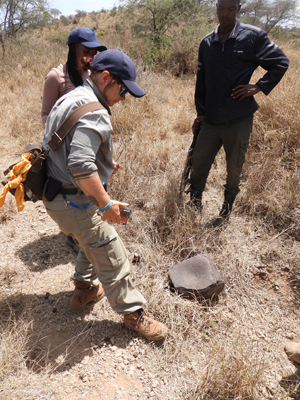
Stone quern on the archaeological site in the Mbalagete Valley (Serengeti). Photo P. Osypiński